
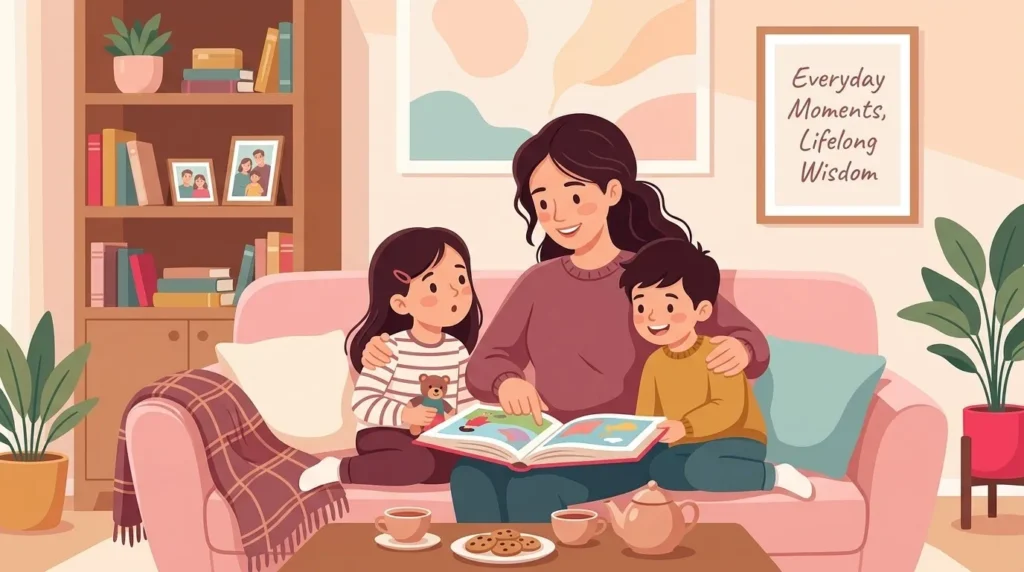
Nobody tells you that the hardest part of being a mother is not the sleepless nights, the tantrums, or the teenage years when they stop talking to you. The hardest part is doing all of it quietly, without applause, and still believing it matters.
I think about this often. About the mothers I have known who never called themselves strong, yet somehow held everything together. The ones who cried in the bathroom so their children would not see, then walked out and made dinner as if nothing had happened. That is motherhood wisdom in its rawest form. Not polished. Not performed. Just real.
This piece is for them — for the ordinary, unremarkable, brilliant women whose inspiring motherhood stories never made it to a magazine cover. And for anyone who finds daily life inspiration not in grand gestures, but in the people who simply keep going.
My grandmother had a saying she repeated so often that we stopped hearing it: “Bend, don’t break.” She was a farmer’s wife who raised five children on land that flooded half the time and dried out the other half. She never talked about resilience. She simply practiced it every single day in ways nobody documented.
That is the thing about motherhood wisdom. It rarely announces itself. It lives in the small things — the way a mother knows which child needs silence and which one needs comfort, the way she stretches a budget in ways that would confuse an economist, or the patience she somehow finds at 11 p.m. on a school night when someone suddenly remembers a project due tomorrow.
A friend of mine, Jessica, raised her three boys in a small flat in South London after her marriage ended. She once told me she never let them see her panic, even when the boiler broke in January and she had no idea how she would afford to fix it. She called sleeping under extra blankets “an adventure.” Her youngest son is now twenty-three and still remembers that winter as one of the happiest times of his childhood. He had no idea what she was carrying. That is not deception. That is motherhood wisdom doing its quiet, invisible work.
There is a reason we tell stories. Not just to remember things, but because hearing another person say, “This happened to me too,” reaches a place advice never can.
The inspiring motherhood stories that stay with people are rarely dramatic rescues or perfect comebacks. They are the stories that feel true. The mother who applied for a job while caring for a sick child and still got it. The woman who returned to studying at forty-two because she wanted her daughter to know it is never too late. The mother who chose sleep over perfection and felt absolutely no guilt about it.
That last one deserves applause.
These stories matter because they give other mothers permission — permission to be imperfect, to choose differently, and to stop comparing their real lives to someone else’s highlight reel. Daily life inspiration does not come from watching extraordinary people succeed. It comes from watching ordinary people refuse to give up.
Ask most adults what they learned from their mothers, and they usually pause. Not because they have nothing to say, but because the answer is somehow everywhere at once.
Understanding how mothers teach life wisdom means looking between the obvious lessons. It is not the lecture about responsibility or the warning about bad choices. It is what a child sees when their mother handles a difficult conversation calmly. It is watching her apologize when she is wrong, rest when she is tired, or continue showing kindness when life is difficult.
My own mother had one rule: she never spoke badly about people in front of us. Not relatives. Not neighbors. Not anyone. I did not understand how much discipline that required until I became an adult myself. Only then did I realize she had been teaching us something without ever saying it out loud.
That is how mothers teach life wisdom. Through what they do when they think nobody is watching. And the truth is, somebody always is.
Barbara had been a stay-at-home mother for seventeen years when her husband lost his job and their financial stability disappeared overnight. She had no recent work history, no updated CV, and a frightening amount of self-doubt. Still, she accepted a part-time admin role and began studying online at night.
Her teenage daughter watched her mother fail one course, retake it, and eventually graduate. Today, that daughter is studying law. When asked why, she says she watched her mother prove something important — not to the world, but to herself. That is the kind of motherhood wisdom that quietly passes from one generation to the next.
Rosa has four children, a full-time job, and a husband who travels most weeks for work. For years she exhausted herself trying to keep everything perfect — the spotless home, healthy dinners, school schedules, and the appearance that she was managing it all effortlessly.
One Saturday morning, she looked at the dishes in the sink and decided to leave them there. Instead, she sat on the sofa with her youngest child and watched cartoons for two hours. Nothing terrible happened. The dishes were still there later, waiting patiently.
She now calls that moment her daily life inspiration turning point — the day she realized being present mattered more than being perfect.
Courtney’s eldest son was struggling badly in school, both socially and academically. Instead of pretending to have all the answers, she sat beside him and admitted, “I don’t know how to help you right now. I need you to tell me.”
They both cried. Then they figured it out together.
She later said that moment changed their relationship completely. It became one of the most meaningful inspiring motherhood stories she now shares with other women in her community. You do not have to know everything. You simply have to stay present.
Many mothers are running on empty while the world keeps asking for more — more patience, more involvement, more productivity, and more proof that they are handling everything perfectly.
As a result, motherhood wisdom often gets buried beneath exhaustion. Women with deep insight into resilience, priorities, and people stop trusting themselves because they are simply too tired to hear their own thoughts clearly.
And the daily life inspiration they provide every single day often goes unnoticed. Not dramatically. Just quietly, in the background, where most motherhood exists.
The answer is not complicated, though it is difficult. Mothers need space to tell their stories honestly, without polishing them first. Because inspiring motherhood stories do not need dramatic sacrifice or perfect endings. Sometimes the story is simply this: “I was scared, but I kept going.”
And honestly, that is enough.
When a child watches their mother navigate life honestly — not perfectly, honestly — they absorb lessons no classroom or self-help book can fully teach.
They learn that hard seasons do not last forever. They learn that asking for help is not failure. They learn that being kind matters more than being impressive. And they learn these things not because someone explained them, but because they watched them lived out every day.
That is motherhood wisdom at its most powerful.
And how mothers teach life wisdom is simple: they live it. Through every imperfect, exhausting, beautiful, and ordinary day. Their children are watching, even when it does not seem like it.
If you are somewhere in the middle of your own story right now — exhausted, uncertain, and wondering whether any of this matters — it does. You just may not be able to see it yet.
Far far away, behind the word mountains, far from the countries Vokalia and Consonantia, there live the blind texts. Separated they live in Bookmarksgrove right at the coast